
How Much Income Do You Need to Get a Residence Permit in Austria in 2026? Austria residence permit income requirements 2026

Published by Christian Sumann - Austrian Immigration & Business Advisory Experts
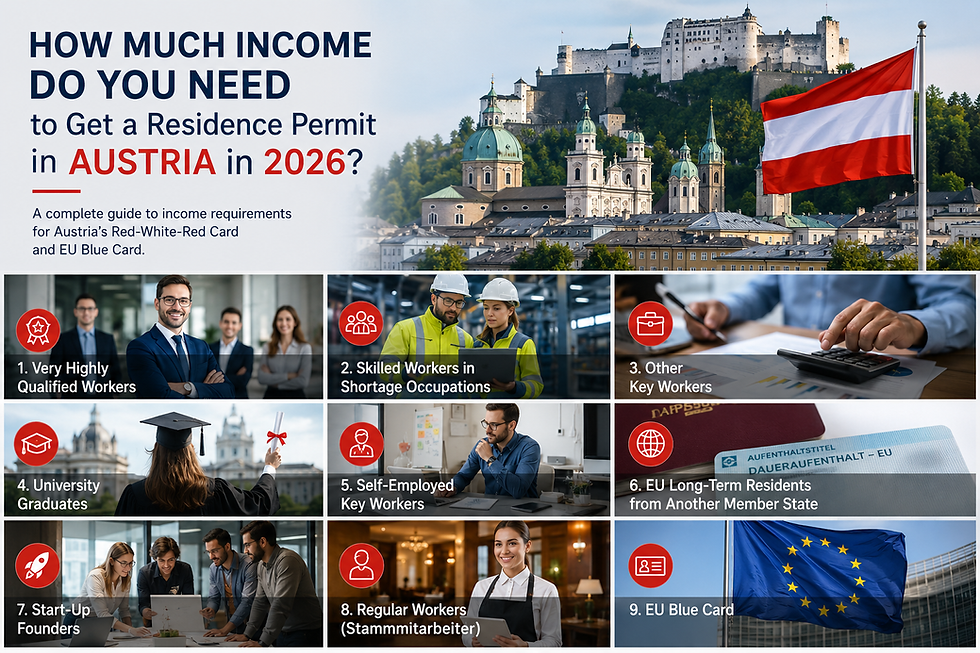
Austria remains one of Europe's most attractive destinations for highly qualified professionals, entrepreneurs, investors, and international graduates. Through its Red-White-Red Card system and the EU Blue Card, Austria offers several pathways for non-EU nationals to obtain residence and work authorization.
One of the most common questions prospective applicants ask is:
"How much income do I need to qualify for an Austrian residence permit in 2026?"
The answer depends entirely on the immigration category. While some permits require a minimum salary threshold, others focus on qualifications, business investments, innovation potential, or economic benefits to Austria.
This guide explains the income requirements for all major Austrian work and residence permit categories in 2026.
Very Highly Qualified Workers (Besonders Hochqualifizierte)
The Red-White-Red Card for Very Highly Qualified Workers is designed for individuals with exceptional qualifications, including senior executives, researchers, scientists, technology experts, and internationally recognized specialists.
Income Requirement in 2026
There is no fixed statutory minimum salary requirement for this category. Instead, applicants must meet the points-based assessment criteria and secure employment that corresponds to their qualifications and professional experience.
While Austrian immigration law does not prescribe a minimum salary, applicants are generally expected to receive compensation appropriate to their expertise and seniority.
Key Takeaway
No fixed minimum income applies, but salaries should reflect the applicant's qualifications and market value.
Skilled Workers in Shortage Occupations (Fachkräfte in Mangelberufen)
Austria updates its annual shortage occupation list to address labour market needs. Eligible professions often include engineers, software developers, healthcare professionals, electricians, metal technicians, and other skilled trades.
Income Requirement in 2026
There is no separate immigration salary threshold for this category.
Applicants must receive at least the salary stipulated by:
The applicable collective bargaining agreement (Kollektivvertrag);
Austrian labour regulations;
Industry-specific wage standards.
Key Takeaway
The required salary depends on the occupation and collective agreement rather than a fixed immigration threshold.
Other Key Workers (Sonstige Schlüsselkräfte)
The Other Key Workers category is intended for qualified professionals who do not fall under the shortage occupation or highly qualified worker categories but possess skills that are valuable to the Austrian labour market.
Income Requirement in 2026
Applicants must earn at least:
€3,465 gross per month
This amount is based on Austria's standard 14 salary payments per year.
Annual Equivalent
€48,510 gross per year
Key Takeaway
This category has one of the most clearly defined statutory salary thresholds within the Red-White-Red Card system.
Graduates of Austrian Universities (Studienabsolventen)
Austria encourages international graduates to remain in the country after completing their studies.
Graduates who receive a job offer related to their qualifications may apply for a Red-White-Red Card without undergoing the standard points-based assessment.
Income Requirement in 2026
There is no fixed minimum salary requirement.
The offered salary must:
Correspond to the position and qualifications;
Meet collective bargaining standards;
Comply with Austrian labour law.
Key Takeaway
This is one of the most accessible pathways to long-term residence and employment in Austria.
Self-Employed Key Workers (Selbstständige Schlüsselkräfte)
This category is intended for entrepreneurs and investors whose business activities provide significant economic benefits to Austria.
Authorities evaluate factors such as:
At least €100,000 Investment volume;
Job creation;
Technology transfer;
Regional economic impact;
Innovation potential.
Income Requirement in 2026
There is no minimum personal salary requirement.
The focus is on the economic significance and sustainability of the proposed business activity.
Key Takeaway
Business impact and economic contribution are more important than personal income levels.
Holders of an EU Long-Term Residence Permit Issued by Another Member State
Individuals holding a valid "Daueraufenthalt – EU" permit issued by another EU member state may relocate to Austria under facilitated conditions.
Income Requirement in 2026
There is no universal minimum salary requirement.
Applicants must demonstrate:
Sufficient financial means;
Suitable accommodation;
Compliance with the requirements of their intended residence purpose.
If employment is planned, the salary must satisfy Austrian labour and collective bargaining standards.
Key Takeaway
Income requirements depend on the applicant's planned activity in Austria.
Start-Up Founders (Start-up Gründer)
Austria actively supports innovative entrepreneurs through the Start-Up Founder category.
Applicants must demonstrate:
An innovative business model;
Entrepreneurial competence;
At least 50 points under the assessment system.
Financial Requirement in 2026
Applicants generally need:
At least €30,000 in start-up capital;
A minimum ownership stake of 50% in the company.
Income Requirement
There is no prescribed personal salary threshold.
Authorities focus on the viability, innovation, and economic benefits of the business.
Key Takeaway
Innovation, investment, and growth potential matter more than personal income.
Regular Workers (Stammmitarbeiter)
Regular workers employed in sectors such as tourism, agriculture, and forestry may qualify for residence and employment under specific provisions of Austrian immigration law.
Income Requirement in 2026
There is no separate immigration salary threshold.
Employers must comply with:
Applicable collective agreements;
Austrian wage regulations;
Industry-specific labour standards.
Key Takeaway
Salary requirements depend on the relevant industry and collective bargaining framework.
EU Blue Card
The EU Blue Card is one of the most sought-after residence permits for highly educated professionals wishing to live and work in Austria.
Typical applicants include:
IT professionals;
Engineers;
Scientists;
Financial experts;
Senior specialists and managers.
Income Requirement in 2026
Applicants must receive a gross annual salary of at least:
€55,678 per year
including special payments.
Monthly Equivalent
Approximately:
€3,977 gross per month based on Austria's 14-salary system.
Advantages of the EU Blue Card
Access to highly qualified employment;
Simplified family reunification;
Greater mobility within the European Union;
A pathway toward long-term residence.
Key Takeaway
The EU Blue Card currently carries the highest statutory salary requirement among Austria's major employment-based residence permits.
Austria Residence Permit Income Requirements 2026: Summary Table
Residence Permit Category | Minimum Income Requirement |
Very Highly Qualified Workers | No fixed minimum salary |
Skilled Workers in Shortage Occupations | Collective agreement salary |
Other Key Workers | €3,465 gross per month |
Austrian University Graduates | Salary according to collective agreement |
Self-Employed Key Workers | No minimum salary requirement |
EU Long-Term Residents from Another Member State | Sufficient means of subsistence |
Start-Up Founders | No salary requirement; generally €30,000 start-up capital |
Regular Workers (Stammmitarbeiter) | Collective agreement salary |
EU Blue Card | €55,678 gross per year |
Why Austria Continues to Attract International Talent
Austria offers a stable economy, high quality of life, excellent healthcare, world-class education, and a strategic location at the heart of Europe. Through the Red-White-Red Card system and the EU Blue Card, Austria continues to attract skilled professionals, entrepreneurs, investors, and graduates from around the world.
While salary requirements are important for certain residence permit categories, Austrian immigration authorities also place significant emphasis on qualifications, labour market demand, innovation, and economic contribution.
Understanding which category best fits your situation is often the key to a successful application.
How GSK Advisory Can Help
At GSK Advisory, we assist Expats, individuals, entrepreneurs, investors, and employers with Austrian immigration and residence permit applications. Our team provides professional guidance on:
Red-White-Red Card applications
EU Blue Card applications
Business immigration and investor residence permits
Start-up founder applications
Residence permits for graduates and skilled workers
Family reunification
Long-term residence planning
Whether you are relocating to Austria for employment, business, or investment purposes, GSK Advisory can guide you through every stage of the process and help maximize your chances of success.
Contact GSK Advisory today to discuss your Austrian residence permit options and receive tailored immigration advice from experienced professionals.
Comments